
Oyster diseases
Bonamia ostreae, Bonamia exitiosa and Marteilia refringens are parasites that can cause disease in certain oysters. The parasite Bonamia ostreae, which can cause the disease bonamiosis, has been found in oysters in Bohuslän. The oysters are safe to eat, but there are restrictions you must follow to reduce the risk of spreading the infection.
Bonamia ostreae in wild oysters in Bohuslän
In November 2025, Bonamia ostreae was confirmed in wild European oysters at Kalvön in Tanum municipality. In February 2026, the same parasite was also detected in wild European oysters in Orust municipality. Tracing the infection and sampling have been ongoing for some time, but the Swedish Board of Agriculture has decided not to apply any eradication measures as it is not considered possible to eradicate the infection completely. Furthermore, the infection may be present across a large geographical area.
The oysters are safe to eat, and there is no risk associated with swimming or fishing in waters where oysters are found. However, it is important to limit the spread of the infection to protect native oyster populations.
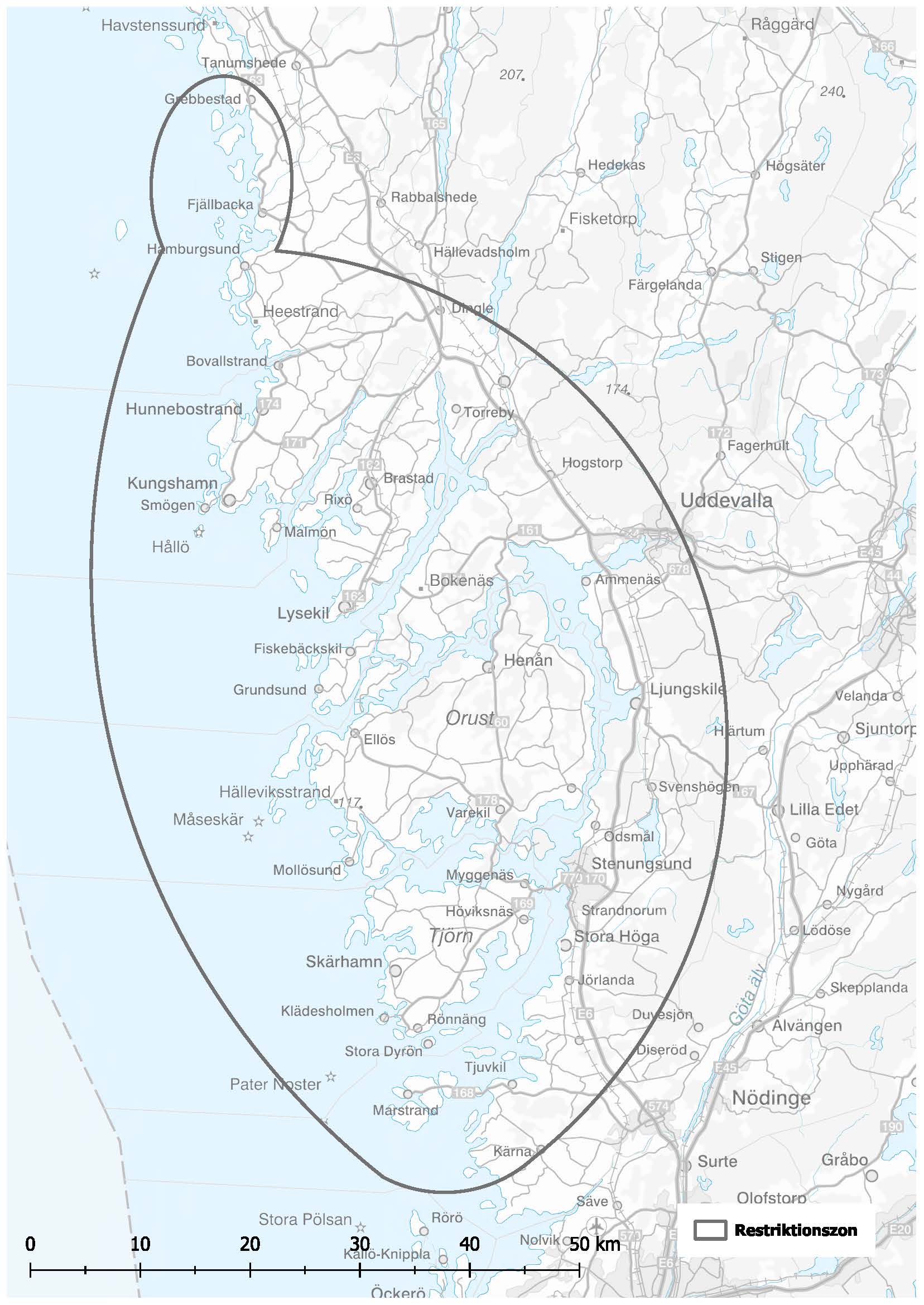
The Swedish Board of Agriculture has established restriction zones with specific rules to reduce the risk of the infection spreading. The zones extend from Grebbestad in the north to just north of Rörö in the south. The map shows the area covered by the restriction zones.
The following applies within a restriction zone
The following applies to those who have the right to harvest oysters:
- You may only harvest wild oysters for processing on land. You must therefore not move the oysters within the same water area or to other water areas.
- Do not throw harvested oysters back into the water.
- You must dispose of oyster shells and oyster remains as general household waste.
- Equipment used for harvesting must be cleaned in a closed system where the wastewater is treated.
The following applies to private persons:
- As a private person, you are normally not permitted to harvest oysters without permission from the fishing rights holder.
- Do not move oysters within the same water area or to other water areas.
- You must dispose of oyster shells and oyster remains as general household waste.
Disease-free status
Sweden has disease-free status for Bonamia exitiosa and Marteilia refringens for the whole territory. For B. ostreae Sweden has disease-free status for the whole territory, except the coastal area from Altarefjorden in the north until Sälö fjord in the south. You can find more information regarding disease-free status for Bonamia ostreae further down this page.
The disease-free status is official through an amendment of regulation (EU) 2021/620.
The oyster diseases
Sweden has a unique coastline. Along the coast around Sweden there is a clear salinity gradient, from almost completely fresh water in the northern Gulf of Bothnia via brackish water in the Baltic Sea to close to oceanic water with high salinity in the Skagerrak. Due to the variation in salinity European oysters can only be found on the west coast. The European oyster is the only susceptible species in Sweden to M. refringens, B. ostreae and B. exitiosa.
There are no imports of oysters from other countries for release in Swedish waters. Sampling of oysters takes place in accordance with the national monitoring plan.
Aquaculture establishments in Sweden receive regular animal health visits.
Wild populations of oysters are sampled as well.
Infection with M. refringens, B. ostreae and B. exitiosa is notifiable. More information about notification obligations and the EU's listed diseases can be found at:
Infection with Bonamia ostreae and Bonamia exitiosa
On 5 November 2025, infection with B. ostreae was detected in Sweden for the first time, in wild oysters in Tanum Municipality. On 4 February 2026, B. ostreae was also confirmed in wild oysters in Orust Municipality on the west coast of Sweden. Infection with B. exitiosa has however, never been detected in Sweden.
Sweden has disease-free status for B. exitiosa for the whole territory. For B. ostreae Sweden has disease-free status for the whole territory except the coastal area from Altarefjorden in the north until Sälö fjord in the south. Please see the map for more information:
For more information:
- Bonamios hos ostron (sva.se) – in Swedish
- Bonamia sp. – EURL for Molluscs Diseases (eurl-mollusc.eu)
- Bonamia exitiosa: Appendix IX (woah.org)
- Bonamia ostreae: Appendix IX (woah.org)
Infection with Marteilia refringens
There are two types of Marteilia refringens: type M which is most often found in mussels and type O which is most often found in oysters. In the past, these two types have been seen as one species. However, research has recently concluded that these two types of M. refringens are two different species. Type M is in some contexts called Marteilia pararefringens.
European oyster (Ostrea edulis) is the only susceptible species in Sweden. M. refringens has never been detected on oysters in Sweden. M. refringens has been detected on blue mussel. The last time M. refringens was detected on blue mussel was in 2015. Blue mussel (Mytilus edulis) is not listed as a susceptible species for M. refringens.
Legislation
Söker efter grundforeskrifter:
2021:10
- Commission implementing regulation (EU) 2021/620 laying down rules for the application of Regulation (EU) 2016/429 of the European Parliament and of the Council as regards the approval of the disease-free and non-vaccination status of certain Member States or zones or compartments thereof as regards certain listed diseases and the approval of eradication programmes for those listed diseases (eur‑lex.europa.eu)
- Commission implementing regulation (EU) 2018/1882 on the application of certain disease prevention and control rules to categories of listed diseases and establishing a list of species and groups of species posing a considerable risk for the spread of those listed diseases (eur‑lex.europa.eu)
- Commission delegated regulation (EU) 2020/689 supplementing regulation (EU) 2016/429 as regards rules for surveillance, eradication programmes, and disease-free status for certain listed and emerging diseases (eur-lex.europa.se)

Revision date: 2026-05-20